Saturday, March 26, 2011

A work in progress

I was told it would be interesting to see one of my Paper Mache Clay (PMC) sculptures as a work in progress.  I’m going to try and share with you some of the steps involved in creating one of my pieces.

I start by making a batch of PMC.  I got the recipe from a website called Ultimate Paper Mache.  This site belongs to Jonni Good who developed this recipe and posted it to share with the rest of us.  This is a fairly inexpensive compound made with paper pulp, joint compound, Elmer’s glue, flour and linseed oil. The hard part is getting all of the ingredients blended together so there are no lumps of paper pulp.  This is also one of my least favorite parts of the whole thing. I bought a hand held electric mixer to use for mixing the “dough” and burned out the motor after only four or five batches.


Next step is deciding what I’m going to make. I know it’s going to be a Santa, but I don’t know anything else about it. Sometimes I will get out the old sketch book and try to recreate on paper one of the many ideas that are floating around in my head.  I might draw several head shots with different hats. I might draw an idea of the complete figure and include choices for color of hat and cloak etc.  Once I have a general idea of what the piece is going to look like I need an armature.


PMC is applied in thin layers over an armature. I don’t like leaving the armature in the piece as I’m afraid it won’t dry thoroughly with it inside, so I need to keep that in mind when making the armature. Once the armature is made I put a plastic grocery bag over the armature and secure it in place. The plastic covered armature is then covered with paper strips that have been coated with flour and water paste. I use a stiff bristled paint brush to smooth the paper strips. I usually apply 2 – 3 layers of strips.  Here comes the first wait for it to dry stage.  You will note that there are many such periods where I have to wait for it to dry throughout this process.


After the paper strips have dried, the first layer of PMC is applied evenly.  Now I’m at the second wait for it to dry stage.  What I’ve made so far is what I refer to as a blank.

Once the blank is completely dried and hardened, it needs to be filed and sanded smooth.  This is another of my least favorite things to do.  PMC dries extremely hard and it takes forever to smooth down the ridges and bumps not to mention all of the dust from filing, grinding and sanding. My sister and I are concerned about the amounts of paper dust that we inhale. We’ve both tried wearing dust masks but found they get in the way of blowing off the dust on the part or drinking from our coffee cup. I’ve tried doing both with a mask on.  I’ve also worn the dumb thing around my neck or on the top of my head for the rest of the day.

Now it’s back to filing and sanding and grinding again. More detail is added to the piece and then more drying time.  This process is repeated until I decide the piece is finished.  Now it has to be completely dried.  Once parts are completed I usually leave them in the oven for several hours and then on the heater vent over night.  The PMC has to be totally dried before it can be painted.


Now the fun part begins.  This is where the piece starts getting interesting.  Arms and mittens, collars and hats, hair and beards and all sorts of fun things are modeled onto the blank.  Anything that protrudes away from the body has to be supported in some manner, so little armatures that remain in place get added onto the blank. I use rolled up bits of cardboard and wads of paper or pieces of egg carton for these add-ons.  Once I’ve added more PMC I’m again at a wait for it to dry stage.  I’ve found that I can hurry the drying along by putting the piece into the oven at 190 degrees or sitting it on a drying rack with a space heater facing it.  My sister has several floor heater vents she sits her pieces on.  I’m not so lucky.


Now, I like this part. Adding color makes the piece come alive.  Once I’m finished painting and the paint has had sufficient time to dry I seal the figure with a satin finish spray sealer.  Next I use an antiquing stain and then another coat of sealer, this time I use a matte finish.


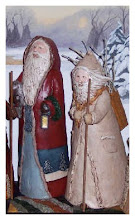
Like every other man, Santa has chores. On this particular day he is going to split logs for the fire place. Since the chopping block is near the stable, he has brought carrots for the reindeer.  We all know that Santa is jolly, so of course he is whistling while he does his chores.


When I sketched this piece I had planned on the scarf only being visible from the back, but decided he should tuck his beard inside his cloak and have the scarf tied in front. I’ve wanted to paint something plaid for a while now and thought this would be the perfect time to do it.

I hope this has been helpful in giving you an idea of how I spend nearly every waking moment of my day. Just joking.

Thanks for dropping by.

Tuesday, March 22, 2011

Ded Moroz (Grandfather Frost)

Whatever you call him, the Gift Bringer of Christmas owes his existence and spirit of generosity to St. Nicholas, Bishop of Myra. Nicholas' Feast Day is December 6th and has been observed in Russia for centuries where St. Nicholas was once known as Father Christmas. St. Nicholas is, also, a Saint in the Roman Catholic Church. During the Soviet Era, the celebration of the Nativity of Christ was forbidden. But, the spirit of St. Nicholas endured in the person of Ded Moroz, Grandfather Frost.

Ded Moroz, or Grandfather Frost, came to Russia in the late 1800s, providing tthat country a counterpart to the Western, secular Santas.
Unlike the Western Santa Claus, Ded Moroz typically is a tall, slender gentleman with a long white beard. He would wear long, lavishly adorned robes. Often, Ded Moroz would be depicted in a costume very similar to a bishop's clerical garb; red Cossack, white lace surplice, long red cape with gold adornment and the tall, pointed Bishop's hat.

During the Soviet Era, Ded Moroz's robes were usually blue. His home is a log house in the wooded village of Viliky Ustyug, Vologodskaya region in northern Russia about 500 miles northeast of Moscow. Ded Moroz travels, of course, in a troika; a decorated sleigh drawn by three horses. He is assisted by Snegurochka (the Snow Maiden) who, it is said, is Ded Moroz's granddaughter. I may decide to sculpt Snegurochka at some future time.

Another difference between Ded Moroz and the Western Santa is the way he delivers his gifts. Ded Moroz does not slide down a chimney nor does he land his sleigh on roof tops. Rather, he visits only good boys and girls, door to door. Like Santa, Ded Moroz will not visit homes where the children are awake; even if they have been good all year long. It is, also, a common practice to leave out food for Ded Moroz, just like Westerners set out cookies and milk for Santa.

When I decided to create my version of Ded Moroz I chose to make him wearing a blue cloak and robes so his appearance would be set apart from some of the other gift-bringers I intend to make which are typically dressed in red. I also thought that it would be fun to paint a pattern on his clothing. I originally thought of painting the snowflakes on the lighter blue of his robes with the darker blue of the cloak but decided that they would look better painted white. I’m glad I made that decision as I’m pleased with the way they look and the way this piece turned out.


Because of all of the blue and white on this piece I wasn’t sure how or if I would use an antique finish on the completed piece. I normally apply a heavy antiquing stain usually walnut over the completed sculpture to age its appearance. I didn’t feel this piece would look right with the brown of the stain and was thinking I’d omit this step. I finally decided to mix a charcoal tint into my antiquing medium. The antiquing softened the white of the snowflakes on his clothing and added depth to his beard.


A friend of my son’s was at our house when I was working on this piece. He’s seen most of the completed pieces but had never seen one in progress. He said the completed pieces look like they could be made of plaster of Paris that someone had painted but after seeing how they look when I’m working on them was something else. He thought I should take pictures of the work in progress and include those pictures when I blog. I may do that at some point but not now.


I’m not sure what my next project will be. I have to make a batch of PMC before I can make anything. I do have what I refer to as a blank drying at the moment, but at this point that’s pretty much what’s in my brain. I haven’t decided who or what it will turn out to be.


Ded Moroz was the 20th piece that I’ve completed since I started sculpting on the 8th of January. Working with PMC is something I’ve done every day since. I don’t do much of anything else. After seeing what some of you have been doing with water colors and pastels, I’ve thought of trying to paint or draw again. I have pencils and water colors. I have acrylic paint and oil paint. I have all types of papers and some canvases, but none of these things are calling to me right now.


Maybe I'll just open a couple of boxes of those supplies and see if anything happens.

Thanks for dropping by.

Wednesday, March 16, 2011

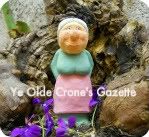
Baboushka

In my research of Santa Claus, I’ve come across several legends from around the world for the figure that represents the spirit of giving in other countries.
Santa Claus is the name we Americans have given to our legend of the Christmas gift-bringer. When referring to the legendary figures of Christmas from other countries we refer to them as Old World Santas when we should probably be calling them old world gift-bringers.  Not all of these gift-bringers were men either as you will learn from the following story. 
In old Russia, one of the most commonly known givers of gifts was an old woman known as Baboushka (which means grandmother in Russian). Baboushka lived alone in a big house that required constant upkeep. She had lived alone for so long that her days and her thoughts were filled only with cleaning, cooking, mending and spinning. She had no family and rarely received visitors. Her large home near the road consumed her days.

One cold evening while scrubbing her floors, she heard a knock at the door. She looked out the window and saw three noblemen, finely dressed so she opened her door to them and invited them in from the cold.

"We are traveling to Bethlehem to find the Child who is born a King and bring him fine gifts," said one of the wise men to her. "Won't you please come with us to find him?"

The old woman explained that her floors were not yet clean and that she could not possibly leave her home. She invited them to rest by the fire and she would prepare them a meal. They said they must not delay their journey so they bid her farewell and went on their way.

Late that night by the light of the fire, she pondered upon the men who had visited her and, more importantly, of the Child of whom they spoke. She regretted deeply, for some reason, not having gone with them now. She gathered a few trinkets from among her meager possessions as gifts for the Child and set off into the cold night to find the noblemen. She walked and walked, inquiring after the traveling men and the Child who would be King but no one knew where to find them.

Legend has it that she continues to this day, traveling the lands in search of them. On Epiphany Eve, she leaves her trinkets in the homes of good children she visits in hopes that they too will search for the Child.

I decided to add to my collection of gift-bringers by sculpting Baboushka. I like the looks of the Russian nesting dolls and let their proportions and shape influence my sculpture. Since she began her search in the 17th century I decided that her clothing was more than likely dark and very simple as she was a woman of little wealth.


I’m working on another Russian gift-giver, Ded Moroz and when I have him completed I will show you how he turns out.

Thankyou for stopping by.
Sincerely,

Maddyrose